
Let’s be honest: most Kenyans don’t wake up excited about insurance.
Infact to many, its rather boring.
For most of us, we buy cover because we must (or because it’s sensible), then we hope we never have to use it. And when we do use it? The experience can feel like a second job—forms, phone calls, follow-ups, and long waiting periods.
In other instances, an engaging and happy insurance sale and on-boarding process that is then follow by a frustrating, cumbersome, tedious and often very rigorous claims and settlement process.
That’s why artificial intelligence (AI) is suddenly becoming a big deal in Kenya’s insurance industry. Not just as a buzzword, but as a practical way to make insurance easier for the customers.
Its faster, fairer, and harder to game—especially in the places both customers and companies should care about most: claims, fraud, underwriting, and customer service.
The evidence: AI isn’t just “nice tech” — it’s linked to performance
A 2025 research paper in the International Journal of Social Science and Human Research (IJSSHR), based on a survey of 71 insurers, found that nearly 4 out of 5 insurers generally agreed they have adopted AI-driven internal processes and across such things as customer services and outreach.
So what does this look like in real life?
Well for one, claims are getting processed faster. This means that the journey from lodging a claim, including how this is done to getting a positive or negative response is faster and less painful.
Claims is where trust is built—or broken. AI helps insurers speed up the workflow by automating what used to take humans hours: reading documents, checking policy limits, verifying data, routing straightforward claims, and escalating only the complex or suspicious ones.
The IJSSHR study lists core internal processes where insurers report AI use, to automated claims processing and natural language processing (NLP) for document review.
It is thus clear that the insurance industry in Kenya is increasingly adopting automation and AI to enhance operational efficiency and customer experience, including automating onboarding, claims submission and adjudication.
From inside a major insurer, Jubilee Health Insurance CEO Njeri Jomo offers a useful reality check: “Technology alone is not the solution—it’s the strategy and intent behind it that matters.”
She opines that while AI is not displacing all the work that was previously done by humans, it can remove bottlenecks so customers aren’t stuck chasing updates for weeks.
Secondly, AI has gotten very good at catching Fraud. Put differently, AI is catching the tricks and crooks that inflate everyone’s else’s premiums.
Fraud is one of the invisible taxes in insurance. When fictitious or inflated claims rise, insurers price defensively and customers feel it through higher premiums and tougher scrutiny.

In May 2025, Jubilee Holdings indicated that it foiled fictitious insurance claims worth KSh400 million in the year ended Dec 2024 after deploying an AI-supported fraud detection tool that helped identify and act on 536 suspicious cases.
According to Jubilee Holdings chairman Zul Abdul: “When the economic environment gets difficult, the level of fraud increases… We have now applied AI to make sure we control fraud.”
Its success has meant that the tool is processing many more claims today at scales
“Today, we are authorising more than 4,000 claims daily without human intervention.” Jubilee’s deputy CEO Juan Cazcarra adds
That’s the customer-facing benefit: quicker authorisations for routine claims and fewer fraud leaks that force the entire pool to subsidize bad behavior.
The benefits are not limited to private sector alone.
For government, the impact of AI has been highly evident, especially in health insurance.
According to Health Cabinet Secretary Aden Duale, Artificial intelligence (AI) has helped the Social Health Authority (SHA) in Kenya uncover cases of suspected fraud nipping it in the bud before the payments were made.
Speaking to legislators during a legislative retreat recently, the CS highlighted how AI-driven fraud detection systems flagged extreme anomalies in claims data, including a case in Kwale County where one parent was registered with 381 dependents under the national health insurance scheme, raising red flags over manipulation of beneficiary records.
‘We are handing this file over to the Directorate of Criminal Investigation for further action’, he said.
It will not be the first time that AI is working overtime for government to safeguard health insurance finds.
In September 2025, The Ministry of Health formally handed over 1,188 case files and supporting evidence to the Directorate of Criminal Investigations (DCI) for further investigation and prosecution, saying they had been flagged by Ministry’s cutting-edge AI-powered fraud detection system, built on a big data engine under TaifaCare health insurance.

For insurance companies, safeguarding their funds has meant innovating in how they apply AI.
Traditionally, for insurance companies, underwriting has relied on broad averages combining pooling and spreading risk.
Today, AI in Insurance in Kenya allows more granular risk profiling and pricing—done responsibly, this can mean fairer premiums and better product fit. In fact, many Kenyan insurers like Heritage insurance combine the use of AI with telematics which enables not just forensic data in case of an accident but also enables the payment of a cash back reward for good driver behavior and no claims by the end of the insurance period.
Dubbed “Heritage Insurance Auto Correct” the solution is a telematics-based, usage-based insurance (UBI) product that rewards safe driving with up to 15% cashback on annual premiums.
“Heritage’s Auto Correct promises a blend of intelligent black-box technology, driver feedback and attractive rewards aimed at improving driver behavior, potentially reducing both accident frequency and the cost of insurance,” says the Managing Director Godfrey Kioi.
Many consumers love the cashback saying no other insurer ever rewards them.
‘For me, I did not believe it when they called me about the cash, but once it hit my M-pesa, I can hardly wait until the next cycle,’ says Lucy, an SUV owner who would usually pay her premium and then wait until there was either a claim or the next premium was due.
‘When did you hear of your insurer just calling to check up on you? I think there must be some technology that is prompting them to check in.’ she quips.
For insurers the benefits go beyond just happy customers. AI is driving better pricing and understanding of risk. In the insurer survey, firms reported AI adoption in data-driven pricing and underwriting, AI-driven premium setting and optimized risk assessment.
This matters because pricing doesn’t have to be as blunt. Over time, better risk understanding can support more tailored covers especially in areas like SMEs, motor, health, and climate-linked products which can be variable without treating everyone as “high risk by default.”
The innovation goes even further to improve access and help battle the region’s low insurance penetration.
Many Kenyans have access to a mobile phone. This has made the issue of financial services in Kenya adopt a mobile first approach.
And as Kenya is mobile-first—so it’s no surprise insurers are pushing AI into customer servicing and distribution.
For example, ICEA LION has marketed its WhatsApp chatbot with a very Kenyan promise: “Anywhere, anytime. ICEA LION’s WhatsApp chatbot ‘LEO’ has got you covered.”
This kind of always-on self-service isn’t just convenience. It reduces cost-to-serve, removes friction from renewals and inquiries, and helps insurers scale without necessarily adding the same proportion of staff. The innovation around the utilization of AI in Insurance in Kenya is contributing to an increasingly smoother customer experience and can handle simple tasks, trouble shooting and sieving and sorting needs before escalating customer requests where necessary.
None of this would have been possible without an enabling environment, created an equally innovative regulator.
In this case, the regulator’s message has been simple: digitise, yes—but protect consumers and the integrity of the market.
While addressing the media at the BimaLab Africa Insurtech Summit 2025 Insurance Regulatory Authority (IRA) CEO Godfrey Kiptum agreed that regulation must evolve as rapidly or even faster than innovation itself does.
“Our responsibility is to ensure a stable, trusted insurance market that protects consumers and to create an environment where innovation can thrive responsibly.” He said.
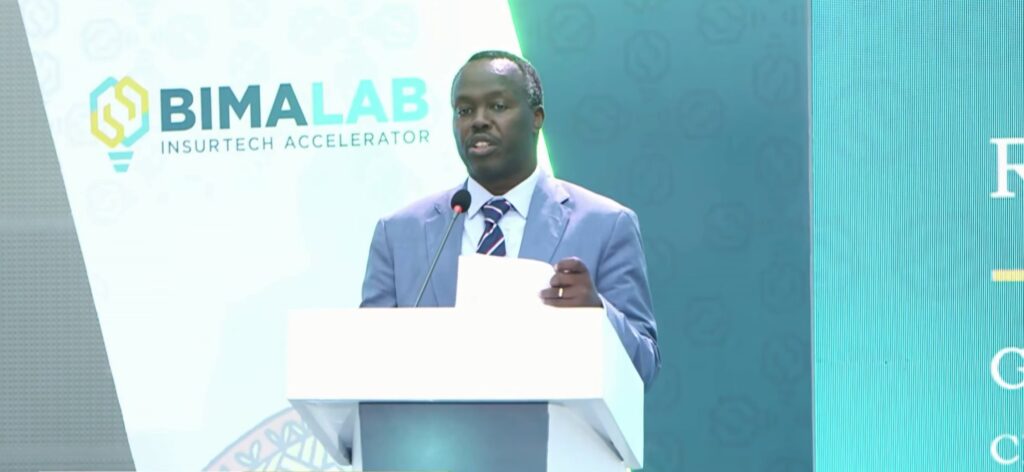
The same remarks point to regulatory sandboxes, guidelines, and stronger cybersecurity and data protection expectations as digital insurance grows and begins to solidify the presence of AI in Insurance in Kenya.
The IJSSHR paper also notes the IRA’s role in supporting controlled innovation through regulatory sandboxes, while highlighting practical challenges such as data quality and availability, and the need for stronger governance and up-skilling.
But the adoption of itself is not without risk.
Experts point to the fact that a robust self-governance structure is required to address potential issues such as—privacy breach issues, biased decisions, or unexplainable claim outcomes that can quickly erode public trust.
One such robust structure is evident through the Global Allianz Group’s Responsible AI Corporate Rules that describe governance structures such as dedicated AI Trust Officers (group and local) and a Group AI Office acting as a centre of excellence—focused on guidance, oversight, incident handling, risk monitoring, and ensuring AI use aligns with responsible principles.
In 2021, Allianz officially acquired a 66% controlling stake in Jubilee Holdings’ general insurance businesses in Kenya. This strategic partnership appears to have given Jubilee a running jump in the adoption of AI for insurance in Kenya.
For the country’s insurers AI is already improving what Kenyans care about most: faster claims, stronger fraud control, smarter underwriting, and more convenient service. But the winners won’t be the companies that “talk AI” the loudest. They’ll be the ones that pair AI with responsible governance—because in insurance, trust is the product.
The proof of this AI pudding will definitely be in the eating.